


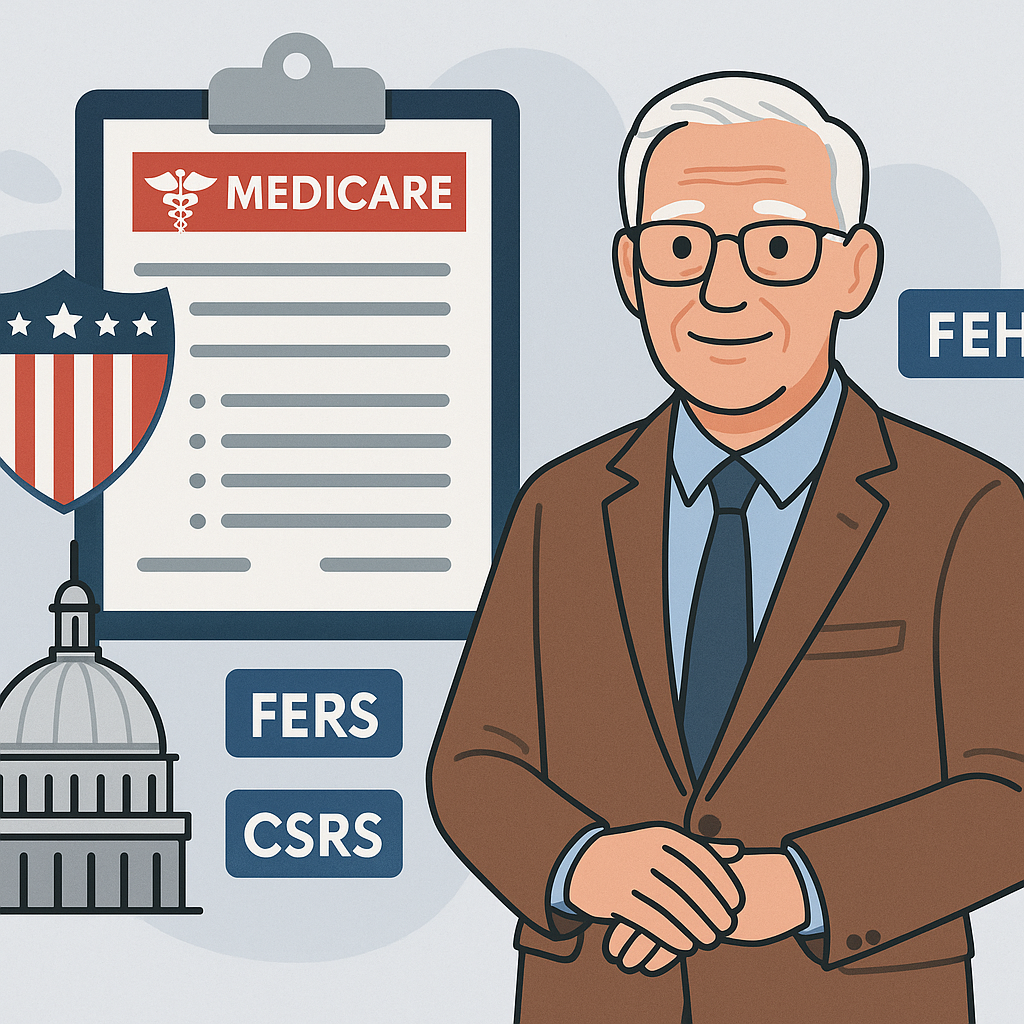
How FEHB Works in Retirement
The Federal Employees Health Benefits (FEHB) program is one of the few employer health plans that continues unchanged into retirement. Unlike most private-sector retiree plans that reduce benefits or increase premiums at 65, FEHB maintains the same coverage, the same plan options, and the same government contribution whether you are 45 or 85. The only requirement is that you were continuously enrolled in FEHB for the five years immediately before retirement (or from your first opportunity to enroll, if less than five years).
When you turn 65, FEHB does not require you to enroll in Medicare. Your FEHB plan continues to be your primary insurance regardless of whether you have Medicare. However, if you do enroll in Medicare, the coordination between the two programs can significantly reduce or eliminate your out-of-pocket costs.
Key Takeaways
- FEHB coverage continues into retirement and does not end when you turn 65 or enroll in Medicare.
- Medicare Part A is free for most federal retirees and should always be enrolled in at 65, as it reduces what FEHB pays for hospital stays.
- Medicare Part B costs $202.90 per month in 2026, but when combined with FEHB it often eliminates your out-of-pocket costs for doctor visits and outpatient care.
- You will not face a Part B late enrollment penalty if you had FEHB coverage continuously, because FEHB qualifies as creditable coverage.
- CSRS retirees who did not pay Medicare taxes for 40 quarters may need to pay a Part A premium ($524/month in 2026) or may choose to skip Part A entirely.
- Most federal retirees do not need a Medigap policy because FEHB plus Medicare provides comprehensive coverage with minimal gaps.
Medicare Part A and Federal Retirees
Not Sure Which Medicare Plan Is Right for You?
Answer a few quick questions and get matched with plans in your area. Free, no obligation.
Get Started FreeMost FERS (Federal Employees Retirement System) retirees qualify for premium-free Medicare Part A because they paid Medicare taxes throughout their federal career. FERS employees have paid the 1.45% Medicare tax since the system began in 1984. If you have 40 or more quarters of Medicare-taxed employment (10 years), Part A is free.
CSRS (Civil Service Retirement System) retirees face a different situation. CSRS employees hired before 1983 were exempt from Medicare taxes. If you spent your entire career under CSRS without other Medicare-taxed employment, you may not have the 40 quarters needed for premium-free Part A. In that case, you can either pay the Part A premium ($524 per month in 2026 for those with fewer than 30 quarters) or decline Part A and rely solely on FEHB.
CSRS Retirees: Check Your Quarters
Even if you spent most of your career under CSRS, you may have earned Medicare-taxed quarters from part-time jobs, military service, or self-employment. Contact the Social Security Administration at ssa.gov/medicare to verify your quarter count before deciding on Part A.
Should You Enroll in Medicare Part B?
This is the central question for every federal retiree at 65. Medicare Part B costs $202.90 per month in 2026 (more if your income triggers IRMAA surcharges). Since FEHB already covers doctor visits, outpatient care, and most of what Part B covers, many retirees wonder whether the additional premium is worth it.
The answer for most federal retirees is yes, and here is why: when Medicare Part B is your primary payer and FEHB is secondary, the two programs together typically cover 100% of your approved medical costs. Medicare pays 80% of the approved amount, and FEHB picks up the remaining 20% as secondary insurance. Without Part B, FEHB alone may leave you responsible for deductibles and coinsurance that would otherwise be covered.
The Financial Math: Part B Premium vs. Out-of-Pocket Savings
| Scenario | FEHB Only | FEHB + Medicare Part B |
|---|---|---|
| Annual premium cost for Part B | $0 | $2,435 ($202.90 x 12) |
| Typical doctor visit copay | $20-$40 per visit | $0 (Medicare + FEHB covers 100%) |
| Outpatient surgery coinsurance | 15-25% of approved amount | $0 in most cases |
| Annual physical/wellness visit | Covered with copay | $0 (Medicare preventive benefit) |
| Durable medical equipment | 20-30% coinsurance | $0 (Medicare 80% + FEHB 20%) |
| Estimated annual out-of-pocket (moderate use) | $1,500-$3,000+ | $0-$200 |
Figures are estimates based on typical FEHB Blue Cross Basic plan. Your specific plan may vary.

I tell every federal retiree the same thing: if you can afford the $202.90 per month, enroll in Part B. The math almost always works in your favor once you start using healthcare regularly. And here is the part most people miss: you can suspend FEHB during Open Season and switch to a cheaper FEHB plan once Medicare is doing the heavy lifting. Many retirees drop from a high-option plan to a basic plan and save $100 or more per month on FEHB premiums, which more than offsets the Part B cost.
How Medicare and FEHB Coordinate Claims
When you have both Medicare and FEHB, Medicare becomes the primary payer for services it covers. Your FEHB plan becomes secondary and pays some or all of the remaining costs. The coordination works automatically once your FEHB plan knows you have Medicare. According to CMS coordination of benefits rules, you do not need to file separate claims with each program. Your provider bills Medicare first, and the remaining balance is sent to FEHB automatically.
Medicare pays first for Part A services (hospital stays, skilled nursing) and Part B services (doctor visits, outpatient care)
FEHB pays second, covering deductibles, coinsurance, and copays that Medicare leaves behind
For services Medicare does not cover (such as routine dental or vision), FEHB remains your only payer and covers them according to your plan's normal rules
Prescription drugs are handled by your FEHB plan's pharmacy benefit or a separate Part D plan (not both)
Do Federal Retirees Need Medicare Part D?
Most federal retirees do not need a separate Medicare Part D plan because FEHB plans include prescription drug coverage that is considered creditable (meaning it is at least as good as standard Part D). As long as your FEHB plan's drug coverage remains creditable, you will not face a Part D late enrollment penalty if you decide to add Part D later.
However, some retirees on very expensive specialty medications find that a standalone Part D plan with the new $2,000 annual out-of-pocket cap offers better protection than their FEHB drug benefit alone. If your FEHB plan charges high coinsurance on specialty drugs, it may be worth comparing your projected costs under FEHB versus a Part D plan with the IRA cap.
Do You Need a Medigap Policy?
In most cases, federal retirees do not need a Medicare Supplement (Medigap) plan because FEHB already functions as secondary insurance to Medicare. A Medigap policy would be a third layer of coverage, and the additional premium is rarely justified when FEHB is already picking up what Medicare leaves behind.
The exception is if you plan to drop FEHB entirely and rely on Medicare alone. In that case, a Medigap plan would fill the 20% coinsurance gap that Medicare Part B leaves. But dropping FEHB is generally not recommended because you cannot re-enroll once you leave the program (with very limited exceptions).
The Part B Late Enrollment Penalty and Federal Retirees
Federal retirees are protected from the Part B late enrollment penalty as long as they maintain continuous FEHB coverage. FEHB is considered creditable coverage by Medicare, which means you can delay Part B enrollment past age 65 without penalty. When you do decide to enroll, you can sign up during a Special Enrollment Period rather than waiting for the General Enrollment Period.
This is different from most employer coverage situations where you must enroll in Part B within 8 months of losing group coverage. With FEHB, there is no 8-month deadline because the coverage continues indefinitely. You can enroll in Part B at 66, 70, or 75 without penalty as long as FEHB was active the entire time.
State and Local Government Pensions
If you are retiring from a state or local government position, your situation depends on whether your employer's retiree health plan continues past 65. Many state pension systems (such as CalPERS, New York State, and Texas ERS) offer retiree health benefits, but the rules vary dramatically by state. Some require Medicare enrollment at 65 and reduce their coverage to a Medicare supplement role. Others terminate retiree health coverage entirely at 65, leaving you with Original Medicare plus whatever supplemental coverage you arrange on your own.
Unlike FEHB, most state and local retiree plans do not guarantee lifetime coverage. Check with your pension system's benefits office well before turning 65 to understand what changes at Medicare eligibility age.
Steps to Take Before You Turn 65
Frequently Asked Questions
Can I keep FEHB and Medicare at the same time?
Will I face a penalty if I delay Part B because I have FEHB?
Should CSRS retirees without 40 quarters pay for Part A?
Do I need a Medigap plan if I have FEHB?
What happens to my FEHB if I enroll in Medicare Advantage?
Find the Right Medicare Plan for Your Area
Get My Plan RecommendationsFrequently Asked Questions
Can I keep FEHB and Medicare at the same time?
Will I face a penalty if I delay Part B because I have FEHB?
Should CSRS retirees without 40 quarters pay for Part A?
Do I need a Medigap plan if I have FEHB?
What happens to my FEHB if I enroll in Medicare Advantage?
Related Articles
Have Medicare questions?
Our licensed Medicare agents are available to help you find the right coverage.