



Medicare is not a single plan you sign up for and forget. It is a system of parts, and how you assemble those parts determines what your coverage looks like, what you pay each month, and how protected you are when something serious happens.
Most people approaching Medicare for the first time are surprised to learn that the government does not hand you a complete coverage package. Instead, you choose a combination from a menu of options. Some combinations are common. Some are not allowed. And some are significantly better suited to certain situations than others.
This guide covers every valid Medicare coverage combination, explains what each one covers and what it costs, and helps you understand the trade-offs so you can make a confident decision.
The Four Parts of Medicare Explained
Not Sure Which Medicare Plan Is Right for You?
Answer a few quick questions and get matched with plans in your area. Free, no obligation.
Get Started FreeBefore looking at combinations, it helps to understand what each part does on its own. Think of the four parts as building blocks.
Medicare is divided into four distinct parts, each covering a different category of healthcare. Here is a quick overview of what each one does and what it typically costs.
| Part | What It Covers | Who Administers It | Typical Monthly Cost (2026) |
|---|---|---|---|
| Part A | Inpatient hospital stays, skilled nursing facility care, hospice, some home health | Federal government (Original Medicare) | $0 for most people (premium-free if you worked 40+ quarters) |
| Part B | Doctor visits, outpatient care, preventive services, durable medical equipment | Federal government (Original Medicare) | $185.00 standard premium |
| Part C (Medicare Advantage) | Replaces Parts A and B; usually includes Part D and extra benefits | Private insurers approved by CMS | $0 to $200+ depending on plan |
| Part D | Prescription drugs | Private insurers approved by CMS | $0 to $100+ depending on plan; avg. $36 in 2026 |
There is also Medigap (Medicare Supplement Insurance), which is not technically a numbered part of Medicare but plays a major role in how people complete their coverage. Medigap is sold by private insurers and helps pay the out-of-pocket costs that Original Medicare leaves behind.
Key Takeaways
- Medicare has four parts: Part A (hospital), Part B (medical), Part C (Medicare Advantage), and Part D (prescription drugs).
- There are two main coverage paths: Original Medicare with add-ons, or Medicare Advantage as an all-in-one plan.
- You cannot combine Medigap (Medicare Supplement) with Medicare Advantage. They are mutually exclusive.
- If you have both Medicare and Medicaid, a Dual Eligible Special Needs Plan (D-SNP) may give you the most comprehensive coverage.
- The right combination depends on your doctors, medications, budget, and how much predictability you want in your costs.
The Two Main Coverage Paths
When you first enroll in Medicare, you face a fundamental fork in the road. You either stay in Original Medicare and build on it, or you switch to Medicare Advantage and let a private insurer bundle everything for you. Every other decision flows from this one.
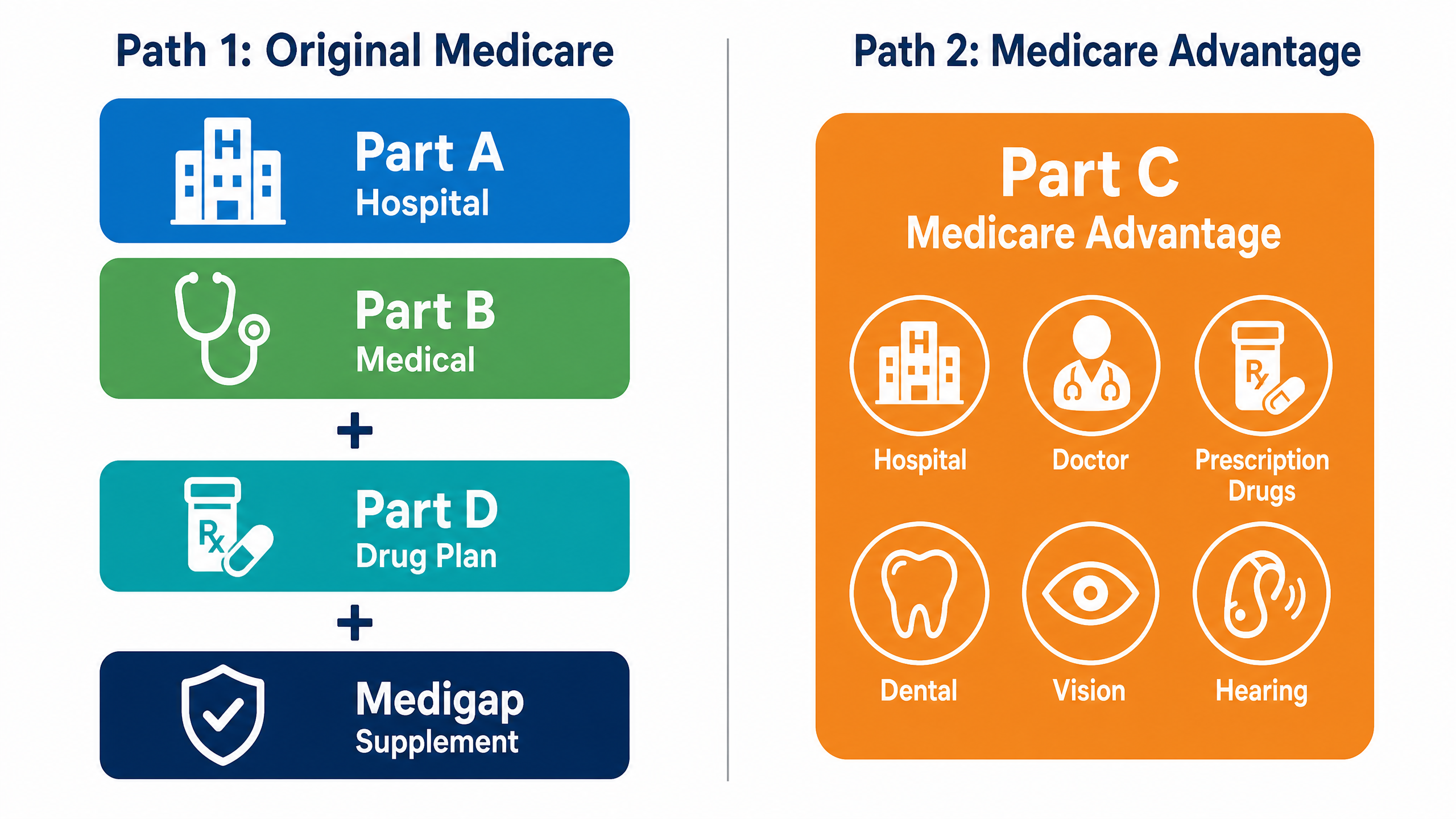
These two paths are not interchangeable. Once you understand the difference between them, the rest of the decision-making process becomes much clearer.
Path 1: Building on Original Medicare
Original Medicare is the foundation of the entire Medicare system. It consists of Part A and Part B, both administered directly by the federal government. When you enroll in Medicare, you are automatically enrolled in Original Medicare unless you actively choose a Medicare Advantage plan instead.
Original Medicare gives you broad access to care. Any doctor, hospital, or specialist that accepts Medicare will accept you, anywhere in the country. There are no networks, no referrals required to see a specialist, and no prior authorization for most services. For people who travel frequently, spend part of the year in another state, or simply want maximum flexibility in choosing their providers, Original Medicare is a strong starting point.
The Gaps in Original Medicare
The problem with stopping at Original Medicare alone is that it leaves significant gaps in your coverage. These gaps can expose you to substantial costs if you have a serious illness or hospital stay.
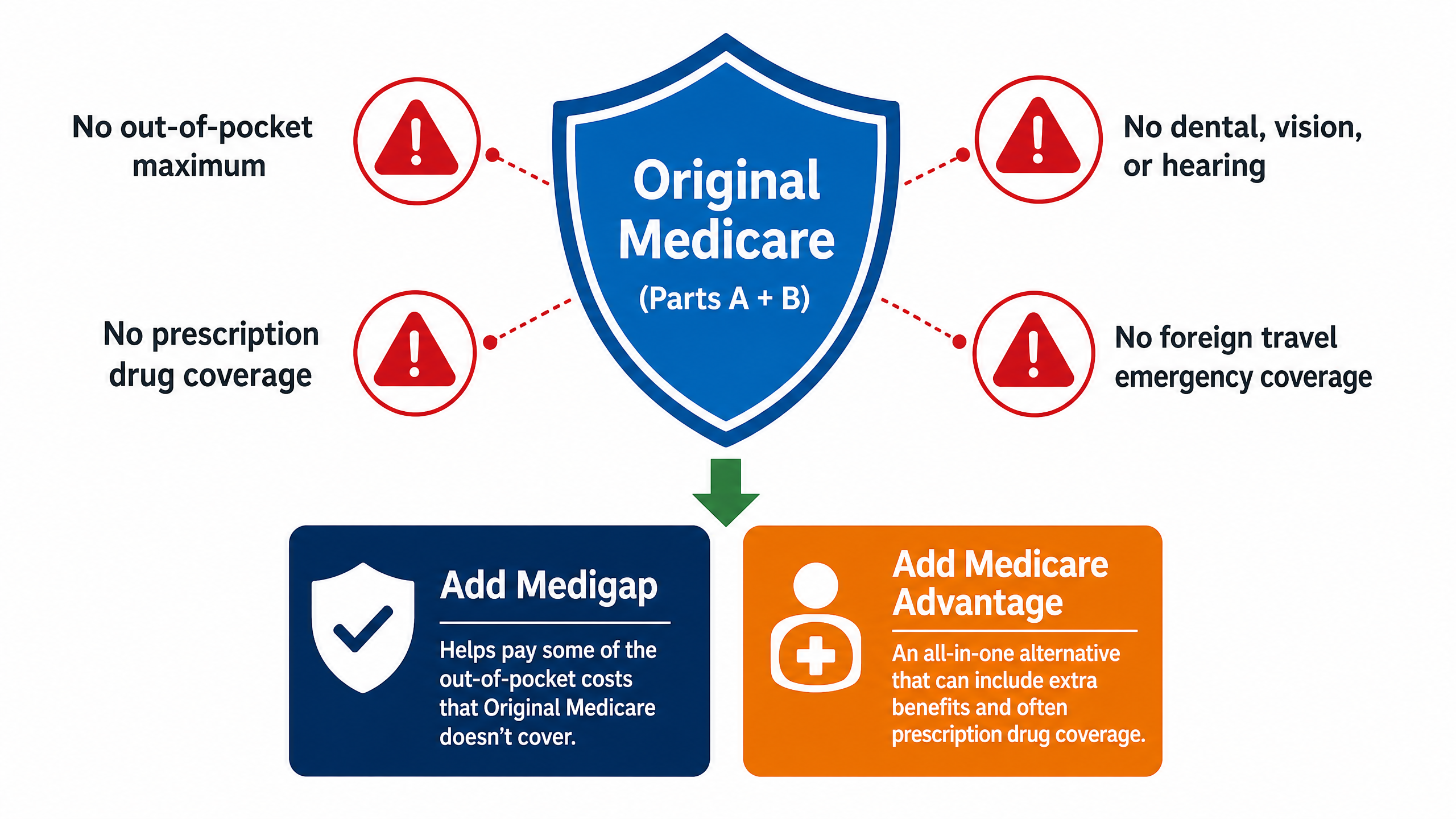
No Out-of-Pocket Maximum
Original Medicare has no annual cap on what you can spend. If you are hospitalized for an extended period, your costs can climb into the tens of thousands of dollars. This is the single biggest financial risk of relying on Original Medicare alone.
The four main gaps are: no limit on your annual out-of-pocket costs, no prescription drug coverage, no routine dental, vision, or hearing benefits, and no coverage for emergency care outside the United States. These gaps are exactly what Part D and Medigap are designed to fill.
Adding Part D to Original Medicare
Medicare Part D is a standalone prescription drug plan that you add to Original Medicare. It is sold by private insurers and covers a wide range of brand-name and generic medications. Plans vary in which drugs they cover (their formulary), what you pay per drug, and which pharmacies are in-network.
Enrolling in Part D is optional, but there is a financial reason to do it even if you take few medications. If you go 63 or more days without creditable drug coverage after becoming eligible for Medicare, you will owe a permanent late enrollment penalty added to your premium for as long as you have Part D. The penalty is 1% of the national base beneficiary premium for every month you went without coverage.
Part D in 2026 and 2027
In 2026, the annual out-of-pocket cap on Part D drug spending is $2,000. Once you reach that amount, your plan covers 100% of your drug costs for the rest of the year. In 2027, that cap is projected to rise to approximately $2,400 following the end of the federal premium subsidy program.
When you have Original Medicare plus a standalone Part D plan, you have hospital coverage, medical coverage, and prescription drug coverage. What you still lack is protection against large out-of-pocket costs for hospital stays and doctor visits. That is where Medigap comes in.
Adding Medigap to Original Medicare
Medigap (Medicare Supplement Insurance) is a private insurance policy that works alongside Original Medicare to pay the costs that Medicare does not cover. These costs include the Part A deductible ($1,736 per benefit period in 2026), the Part B coinsurance (typically 20% of the Medicare-approved amount), and in some plans, foreign travel emergency coverage.
There are ten standardized Medigap plan types, labeled A through N. The most popular plans are Plan G and Plan N. Plan G covers nearly everything except the Part B deductible ($257 in 2026). Plan N covers the same costs but requires small copays for some office visits and does not cover Part B excess charges.
| Benefit | Plan G | Plan N |
|---|---|---|
| Part A deductible | Covered | Covered |
| Part A coinsurance and hospital costs | Covered | Covered |
| Part B deductible | Not covered | Not covered |
| Part B coinsurance | Covered | Covered (with copays up to $20) |
| Part B excess charges | Covered | Not covered |
| Skilled nursing facility coinsurance | Covered | Covered |
| Foreign travel emergency (up to plan limits) | 80% covered | 80% covered |
| Typical monthly premium | $100 to $200+ | $80 to $160+ |
The most important thing to know about Medigap is when to enroll. Your Medigap Open Enrollment Period is a six-month window that begins the month you turn 65 and are enrolled in Part B. During this window, insurers cannot deny you coverage or charge you more based on your health history. Once this window closes, you may be subject to medical underwriting, which means you could be denied or charged significantly higher premiums.
Path 2: Medicare Advantage (Part C)
Medicare Advantage is the alternative to building on Original Medicare. Instead of keeping Parts A and B with the federal government and adding separate plans, you enroll in a Medicare Advantage plan offered by a private insurer. That plan then takes over your Medicare coverage entirely.
Medicare Advantage plans are required by law to cover everything that Original Medicare covers, and most plans go further by including prescription drug coverage (MAPD plans), dental, vision, hearing, fitness benefits, and over-the-counter allowances. Many plans have a $0 monthly premium, though you still pay your Part B premium.
What Medicare Advantage Plans May Include
Prescription drug coverage (MAPD), routine dental cleanings and X-rays, vision exams and eyewear allowances, hearing exams and hearing aid allowances, SilverSneakers or gym membership, over-the-counter product allowances, transportation to medical appointments, and meal delivery after a hospital stay.
The trade-off is that Medicare Advantage plans use networks. Most plans are HMOs or PPOs, which means you generally need to use in-network providers to get the lowest costs, and HMO plans typically require referrals to see specialists. If you travel frequently or have specialists you want to keep seeing, you need to verify they are in-network before enrolling.
Medicare Advantage plans also have an annual out-of-pocket maximum on medical costs, which Original Medicare does not. In 2026, the federal limit on that maximum is $9,350 for in-network services. Once you hit that limit, the plan covers 100% of your covered medical costs for the rest of the year.
Medigap vs. Medicare Advantage: The Core Trade-Off
The choice between Original Medicare with Medigap and Medicare Advantage is the most consequential decision most Medicare beneficiaries make. There is no universally correct answer. The right choice depends on your health, your finances, your providers, and your priorities.
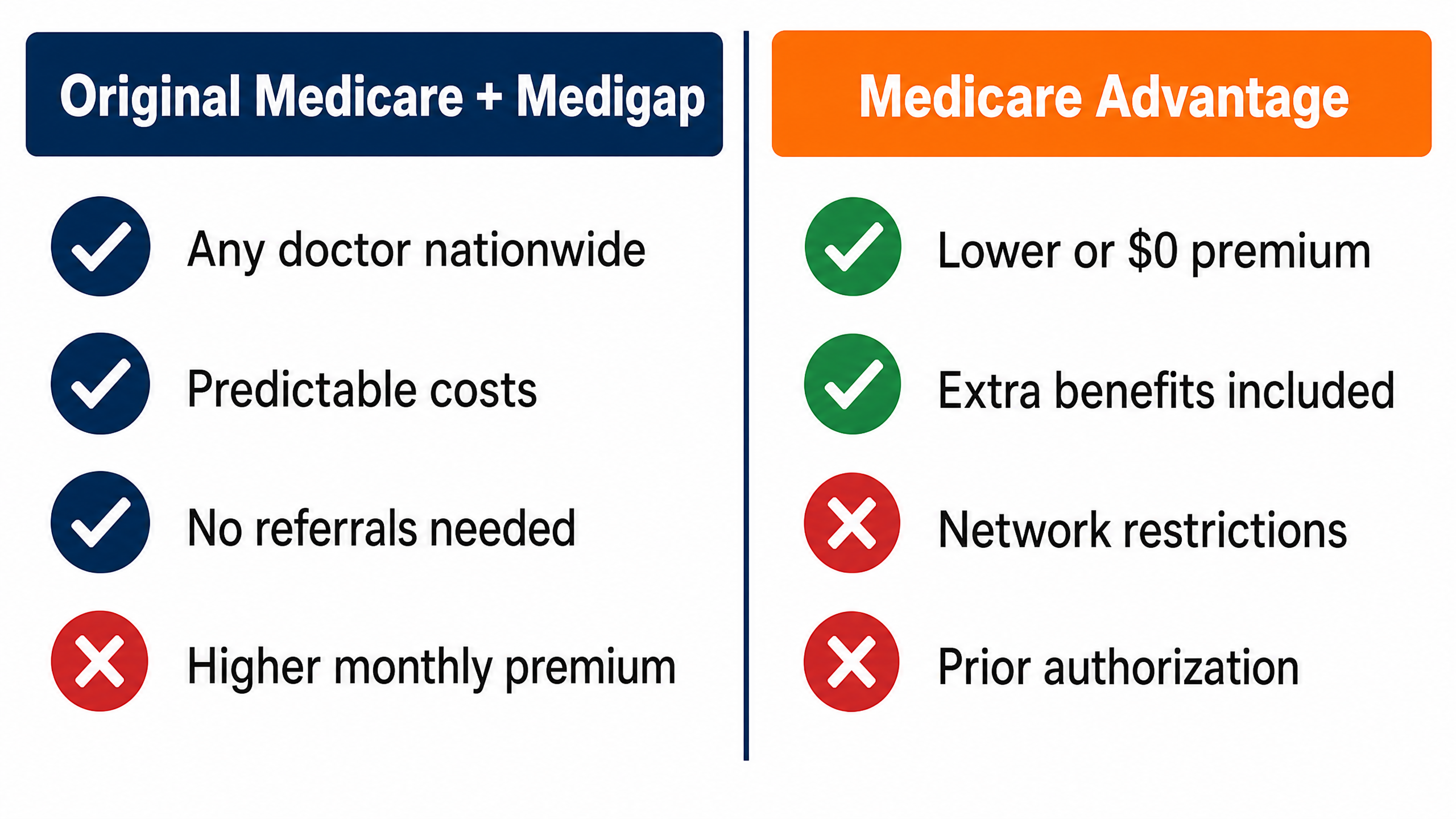
| Factor | Original Medicare + Medigap + Part D | Medicare Advantage |
|---|---|---|
| Monthly premium | Higher (Part B + Medigap + Part D) | Lower (Part B only, often $0 MA premium) |
| Out-of-pocket predictability | Very high (Medigap covers most costs) | Moderate (subject to copays up to MOOP) |
| Provider access | Any Medicare-accepting provider nationwide | In-network providers only (for HMO plans) |
| Referrals for specialists | Not required | Required for HMO plans |
| Prescription drug coverage | Separate Part D plan required | Usually included (MAPD) |
| Dental, vision, hearing | Not covered | Often included |
| Foreign travel emergency | Covered by most Medigap plans | Not covered (except for emergency) |
| Best for | People who want flexibility, travel, or have complex health needs | People who want lower monthly costs and extra benefits |
One important note: if you are considering switching from Medicare Advantage back to Original Medicare and Medigap, the process is more complicated than it sounds. You have a right to switch during the Medicare Advantage Open Enrollment Period (January 1 through March 31), but if you want to enroll in Medigap at that point, insurers in most states can subject you to medical underwriting. Switching from Medicare Advantage to a Medigap plan requires careful planning.
What You Cannot Combine
This is one of the most common points of confusion in Medicare, and it is worth stating clearly: you cannot have both a Medigap plan and a Medicare Advantage plan at the same time.
Medigap + Medicare Advantage Is Not Allowed
If you are enrolled in Medicare Advantage, it is illegal for an insurer to sell you a Medigap policy. Medigap is designed to supplement Original Medicare, not Medicare Advantage. If you currently have both, you are likely paying for a Medigap policy that is not covering anything.
Similarly, you cannot have two Medicare Advantage plans at the same time, and you cannot have a standalone Part D plan while enrolled in a Medicare Advantage plan that already includes drug coverage (MAPD). If you want drug coverage with Medicare Advantage, it must come from the plan itself.
| Combination | Valid? | Notes |
|---|---|---|
| Part A + Part B (Original Medicare) | Yes | The foundation of all coverage |
| Part A + Part B + Part D | Yes | Adds drug coverage to Original Medicare |
| Part A + Part B + Medigap | Yes | Adds cost protection but no drug coverage |
| Part A + Part B + Part D + Medigap | Yes | The most comprehensive Original Medicare combination |
| Medicare Advantage (Part C) alone | Yes | Replaces Parts A and B; may not include drugs |
| Medicare Advantage + Part D (MAPD) | Yes | Most common MA plan type |
| Medicare Advantage + Medigap | No | Not permitted; Medigap does not work with MA |
| Two Medicare Advantage plans | No | You can only be enrolled in one MA plan at a time |
| Medicare Advantage + standalone Part D | No | Not allowed if MA plan already includes drug coverage |
Medicare and Medicaid Together: Dual Eligibility
If you qualify for both Medicare and Medicaid, you are considered dual eligible. About 12 million Americans fall into this category, and they have access to a coverage option that most Medicare beneficiaries do not: the Dual Eligible Special Needs Plan, or D-SNP.
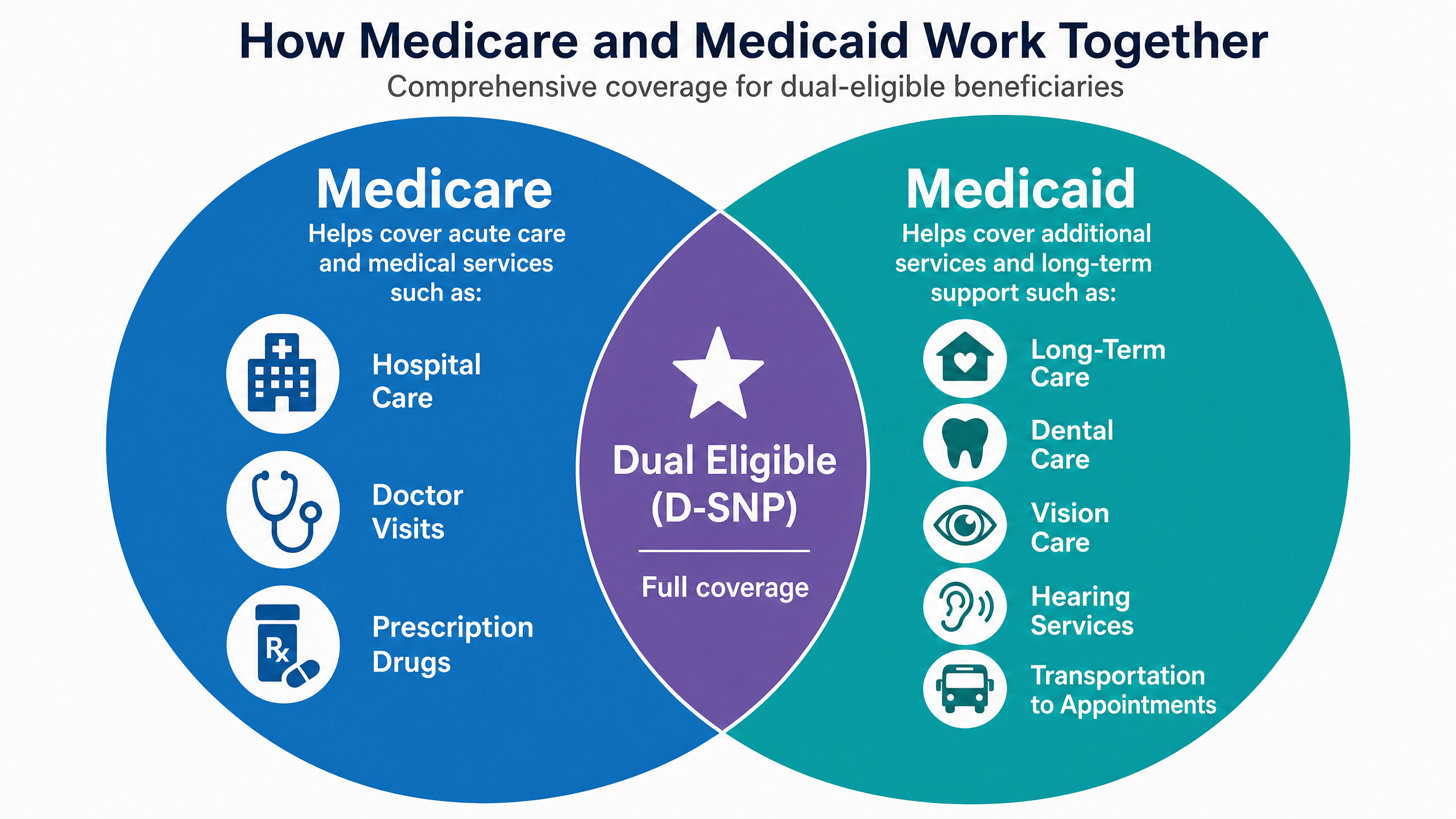
D-SNPs are a type of Medicare Advantage plan specifically designed for people with both Medicare and Medicaid. They coordinate benefits across both programs, which means you typically have very low or zero out-of-pocket costs for most services. Many D-SNPs also include enhanced dental, vision, hearing, transportation, and food assistance benefits.
If you are dual eligible and not enrolled in a D-SNP, it is worth comparing your current coverage against what a D-SNP in your area would provide. The coordination of benefits alone can save you significant money each year.
Full Combination Comparison Table
Here is a summary of every major Medicare coverage combination, what it includes, and who it tends to work best for.
| Coverage Combination | Hospital | Medical | Drugs | Cost Protection | Extra Benefits | Best For |
|---|---|---|---|---|---|---|
| Part A + Part B only | Yes | Yes | No | None | None | Almost no one (too many gaps) |
| Part A + Part B + Part D | Yes | Yes | Yes | None | None | People with very low health costs and minimal hospitalization risk |
| Part A + Part B + Medigap | Yes | Yes | No | High | Some plans include foreign travel | People who want cost predictability but take few medications |
| Part A + Part B + Part D + Medigap | Yes | Yes | Yes | High | Foreign travel (most plans) | People who want maximum coverage and flexibility |
| Medicare Advantage (no drug coverage) | Yes | Yes | No | MOOP limit | Dental, vision, hearing | Rare; most MA plans include drugs |
| Medicare Advantage + Part D (MAPD) | Yes | Yes | Yes | MOOP limit | Dental, vision, hearing, fitness | People who want lower premiums and bundled benefits |
| Medicare + Medicaid (D-SNP) | Yes | Yes | Yes | Very high | Extensive extra benefits | Dual-eligible beneficiaries |
Which Combination Is Right for You?
There is no single right answer, but there are patterns that tend to point people toward one path or the other.
Original Medicare with Medigap and Part D tends to work well for people who have established relationships with specialists they want to keep, travel frequently or split time between states, have complex or ongoing health conditions that require predictable costs, or are willing to pay a higher monthly premium in exchange for fewer surprises at the point of care.
Medicare Advantage tends to work well for people who are generally healthy and want to minimize their monthly premium, live in an area with strong Medicare Advantage plan options and broad networks, value extra benefits like dental, vision, and hearing, or are comfortable working within a network and using referrals for specialists.
The Most Important Thing to Do Before You Decide
Before choosing any Medicare combination, verify that your current doctors, specialists, and preferred hospitals accept the plan you are considering. For Medicare Advantage, check the plan's provider directory. For Medigap, confirm the provider accepts Medicare assignment. Provider access is the most common source of regret after enrollment.
If you are not sure where to start, a licensed Medicare agent can walk you through the options available in your zip code at no cost to you. Agents who specialize in Medicare are paid by the insurance companies, not by you, so there is no charge for their guidance. You can also use Medicare Plan Finder at Medicare.gov to compare plans based on your specific medications and providers.
Find the Right Medicare Plan for Your Area
Get My Plan RecommendationsFrequently Asked Questions
Can I have Medicare Part A and Part B without any other coverage?
Can I have both Medigap and Medicare Advantage?
Do I need a separate Part D plan if I have Medicare Advantage?
What happens if I miss my Medigap Open Enrollment Period?
Can I switch from Medicare Advantage back to Original Medicare?
What is a D-SNP and who qualifies?
Is there a penalty for not enrolling in Part D?
Can I have Medicare and employer coverage at the same time?
Related Articles
Have Medicare questions?
Our licensed Medicare agents are available to help you find the right coverage.