


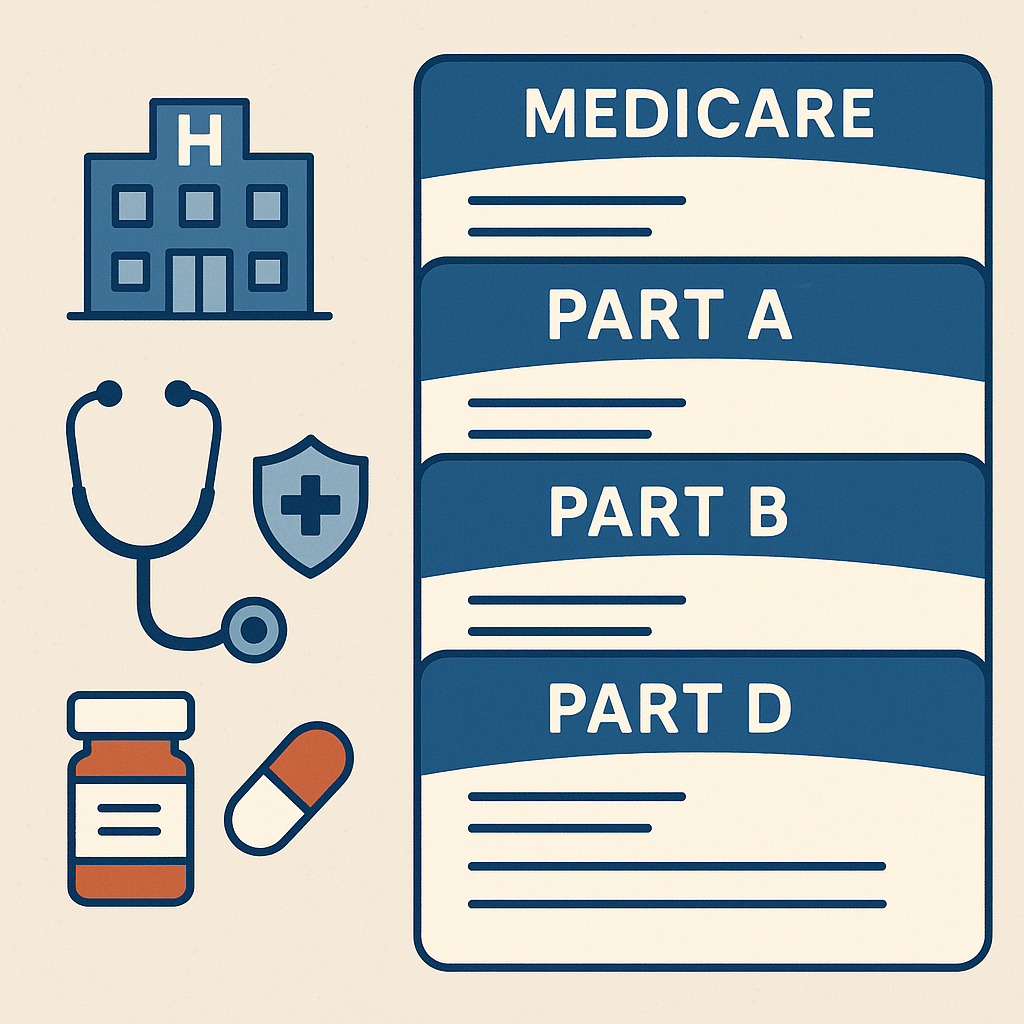
Medicare Parts A, B, C, and D Explained Simply
Prefer to listen? Join the discussion and hear the most frequently asked questions made simple with our experts!
Introduction to Medicare: Understanding the Four Essential Parts
Medicare turns 61 this year, yet millions of Americans still find themselves confused about what it actually covers, and what it doesn't. The program is built on four distinct parts, each designed to cover a different slice of your healthcare. Part A handles hospital stays, Part B covers doctor visits and outpatient care, Part C offers an all-in-one private plan alternative, and Part D focuses on prescription drugs.
Understanding how these parts fit together is the first step toward choosing coverage that protects both your health and your wallet in 2026. The right combination depends on your doctors, your medications, and your budget, not just the lowest monthly premium.
Key Takeaways
- Original Medicare (Parts A and B) forms the foundation, but most people need additional coverage to limit out-of-pocket costs.
- Medicare Advantage (Part C) bundles your benefits through a private insurer, often adding dental, vision, and drug coverage in one plan.
- Missing your enrollment window can trigger permanent premium penalties for Part B and Part D, so timing matters significantly.
- In 2026, the standard Part B premium is $202.90/month and the Part A hospital deductible is $1,736 per benefit period, knowing these figures helps you plan your healthcare budget.
Medicare Parts A, B, C, and D Explained: Quick Summary
Medicare Part A is your hospital insurance. It covers inpatient stays, skilled nursing facility care, hospice services, and certain home health visits.
Medicare Part B is your medical insurance. It pays for doctor visits, outpatient procedures, preventive screenings, and durable medical equipment.
Medicare Part C, known as Medicare Advantage, is an alternative to Original Medicare offered through private insurers. Most plans bundle Parts A, B, and D together, and many add extra benefits like dental and vision.
Medicare Part D covers prescription drugs. These standalone plans are sold by private companies and can be added to Original Medicare or are often built into Medicare Advantage plans.
| Part | Coverage Type | Premium (2026) | Deductible (2026) | Who It's For |
|---|---|---|---|---|
| Part A | Hospital Insurance (inpatient care, SNF, hospice) | Most pay $0 | $1,736 per benefit period | Those needing inpatient hospital or skilled nursing care. |
| Part B | Medical Insurance (doctor visits, outpatient care, preventive services) | Standard $202.90/month (income-adjusted) | $283 annually | Everyone needing doctor visits, tests, and outpatient services. |
| Part C (Medicare Advantage) | All-in-one alternative to Original Medicare (A & B, often D, plus extras) | Varies by plan, often $0 (plus Part B premium) | Varies by plan (Max Out-of-Pocket $9,250) | Those who prefer bundled benefits, often with lower premiums and extra services, willing to use network providers. |
| Part D | Prescription Drug Coverage | Average $34.50/month (income-adjusted) | Max $615 annually | Everyone needing prescription drug coverage. |
Deep Dive into Original Medicare: Parts A & B
Original Medicare, the combination of Part A and Part B, is the federal foundation of Medicare coverage. Most people start here, and many then add a supplement or drug plan on top. Before you decide what to add, you need to know exactly what Parts A and B cover, and what they leave behind.
What is Medicare Part A and What Does it Cover?
In short: Part A is your hospital insurance. When you're admitted as an inpatient, Part A covers your semi-private room, meals, general nursing care, and medications administered during your stay. It also covers care at a skilled nursing facility (SNF) after a qualifying hospital stay, hospice services, and certain home health visits.
Most people pay no premium for Part A. If you or your spouse worked and paid Medicare taxes for at least 40 quarters (10 years), you've already earned premium-free Part A. If you have fewer than 30 quarters of work credits, the 2026 full premium is $565 per month. Those with 30–39 quarters pay a reduced rate of $311 per month.
Part A does not have a monthly premium for most people, but it does have a per-benefit-period deductible. In 2026, that deductible is $1,736. After day 60 of a hospital stay, you also owe daily coinsurance $434 per day for days 61–90, and $868 per day for lifetime reserve days beyond that.
For skilled nursing facility stays, the first 20 days are fully covered after a qualifying hospital stay. From day 21 through day 100, you pay $217 per day in coinsurance. After day 100, Medicare pays nothing, which is why many people explore Medicare coverage for skilled nursing facilities before they ever need one.
Part A does not cover long-term custodial care, the kind of daily assistance with bathing, dressing, or eating in a nursing home. That's a common and costly misconception.
What is Medicare Part B and What Does it Cover?
In short: Part B covers the medical services you use on a regular basis. That includes visits to your primary care doctor and specialists, outpatient surgery, lab tests, X-rays, preventive screenings, mental health services, and durable medical equipment like walkers or oxygen equipment.
The standard Part B premium in 2026 is $202.90 per month. If your income is above certain thresholds, you'll pay more due to the Income-Related Monthly Adjustment Amount (IRMAA). Individuals with income above $109,000 (based on your 2024 tax return) will pay a higher premium, ranging up to $689.90 per month at the highest income level.
The 2026 Part B annual deductible is $283. Once you meet it, Medicare pays 80% of the approved amount for covered services. You owe the remaining 20% coinsurance, with no annual cap. That open-ended 20% is exactly why many people add a Medigap or Medicare Advantage plan on top of Original Medicare.
Part B also covers many preventive services at no cost to you when you see a Medicare-participating provider. Annual wellness visits, flu shots, diabetes screenings, and certain cancer screenings fall into this category. Taking advantage of these services regularly can catch problems early and keep costs lower over time.
Understanding Medicare Part C: Medicare Advantage
Original Medicare vs. Medicare Advantage: Key Differences
In short: Original Medicare is run directly by the federal government and lets you see any provider who accepts Medicare nationwide. Medicare Advantage is delivered through private insurers, often with network restrictions but additional benefits like dental and vision.
Medicare Part C, or Medicare Advantage, gives you an alternative path to receiving your Medicare benefits. Instead of getting coverage directly from the federal government, you enroll in a plan offered by a private insurance company that has been approved by Medicare.
What is Medicare Part C (Medicare Advantage)?
In short: Medicare Advantage plans must cover everything that Original Medicare covers, all your Part A and Part B benefits. But they operate differently. Most plans use a network of doctors and hospitals, such as an HMO or PPO structure, meaning your choice of providers may be more limited than with Original Medicare.
The real draw for many people is the extra benefits. A large share of Medicare Advantage plans include Part D prescription drug coverage, dental, vision, hearing, and fitness programs like SilverSneakers. These additions can provide meaningful value, especially if you'd otherwise pay separately for each service.
You still pay your Part B premium of $202. 90 per month. On top of that, some plans charge an additional monthly premium, while others advertise a $0 premium. However, you should look beyond the premium. Plans have their own deductibles, copayments, and coinsurance, and the maximum out-of-pocket limit for Medicare Advantage plans in 2026 is capped at $9,250 for in-network services.
Before choosing a Medicare Advantage plan, confirm your current doctors are in-network and that your prescriptions are on the plan's formulary. A plan with a low premium but a narrow network could end up costing you more if your preferred specialists aren't covered.
Exploring Medicare Part D: Prescription Drug Coverage
For many Medicare beneficiaries, prescription drugs represent one of the largest ongoing healthcare expenses. Medicare Part D exists specifically to help manage those costs through private plans that cover both brand-name and generic medications.
What is Medicare Part D and How Does it Work?
In short: Part D plans are sold by private insurance companies. You can get a standalone Part D plan to pair with Original Medicare, or you can get drug coverage bundled into a Medicare Advantage plan. Each plan has a formulary a list of covered drugs organized into cost tiers. Generic drugs typically sit in lower tiers with smaller copays, while specialty drugs land in higher tiers with larger cost-sharing.
In 2026, the average Part D premium is approximately $34.50 per month, though this varies by plan and location. The maximum allowable deductible is $615. Once you meet the deductible, you pay your share of drug costs until you reach the catastrophic coverage threshold of $2,100 in out-of-pocket drug spending, at which point your cost-sharing drops significantly for the rest of the year.
Higher-income beneficiaries also pay an IRMAA surcharge on top of their Part D premium, ranging from an extra $14.50 to $91.00 per month depending on income. This surcharge is in addition to whatever premium your specific plan charges.
One important change in 2026: the restructured Part D benefit now caps your annual out-of-pocket drug spending at $2,100, offering more predictability than in previous years. If your medication costs are high, this cap can provide meaningful financial relief. You can learn more about how Part D is changing in 2026 to understand how the new structure affects your specific situation.

Before comparing Part D plans during Open Enrollment, write down the exact names, dosages, and frequencies of every prescription you take. Then use Medicare's Plan Finder tool at Medicare.gov to enter your drug list and compare your actual estimated annual costs, not just the monthly premium, across available plans in your zip code. This single step can save hundreds of dollars per year.
Key Enrollment Periods and Avoiding Penalties
Knowing when to enroll in Medicare matters just as much as knowing what to enroll in. Missing a deadline doesn't just delay your coverage, it can trigger permanent financial penalties that follow you for the rest of your life.
What is the Initial Enrollment Period (IEP)?
In short: Your Initial Enrollment Period is a 7-month window centered around your 65th birthday. It starts three months before the month you turn 65, includes your birthday month, and runs three months after it. This is your primary window to sign up for Parts A, B, and D.
Enrolling in the first three months of your IEP means your coverage typically starts on the first day of your birthday month. If you wait until the final months of your IEP, coverage is delayed. To understand exactly when Medicare starts based on your enrollment timing, reviewing the specific effective dates is worth doing early.
If you miss your IEP entirely without having other creditable coverage, you'll need to wait for the General Enrollment Period (January 1 – March 31 each year), with coverage starting July 1. That gap in coverage alone is a strong reason to plan ahead.
What is a Special Enrollment Period (SEP)?
In short: A Special Enrollment Period lets you sign up for Medicare or switch plans outside the standard windows when a qualifying life event occurs. The most common trigger is losing employer-sponsored health coverage. If you or your spouse had coverage through an active employer and that coverage ends, a SEP opens, giving you 8 months to enroll in Part B without penalty.
Other qualifying events include moving out of your current plan's service area, gaining or losing Medicaid eligibility, or your plan leaving the Medicare program. Each SEP has its own rules and time limits, so acting quickly after a qualifying event is essential. If you're still employed past 65 and covered by your employer's plan, your SEP opens once that coverage ends, not when you retire.
How Do Late Enrollment Penalties Work?
In short: The Part B late enrollment penalty adds 10% to your monthly premium for each full 12-month period you were eligible but didn't enroll and lacked other creditable coverage. That penalty is permanent, it never goes away.
The Part D late enrollment penalty is calculated differently. For every month you go without creditable prescription drug coverage after becoming eligible, you owe 1% of the national base beneficiary premium ($38. 99 in 2026) times the number of uncovered months.
Like the Part B penalty, it's added to your premium for as long as you have Part D.
The takeaway: if you don't have creditable coverage from another source, enroll when you're first eligible. The penalties compound quickly and last a lifetime.
If you have employer coverage past age 65 and plan to delay Medicare, ask your HR department for a written statement confirming your employer plan qualifies as creditable coverage. Keep this document on file. When you do eventually enroll in Medicare, you'll need proof of creditable coverage to avoid the late enrollment penalty, and verbal confirmations won't be enough.
Supplementing Original Medicare: Medigap
Original Medicare leaves real gaps in coverage. The unlimited 20% coinsurance under Part B and the per-benefit-period deductible under Part A can add up fast, especially if you're managing a chronic condition or face a major health event.
What is Medigap and How Does it Work?
In short: Medigap, also called Medicare Supplement Insurance, is sold by private insurance companies and designed to cover the out-of-pocket costs that Original Medicare doesn't pay. Depending on the plan you choose, Medigap can cover your Part A deductible, Part B coinsurance, skilled nursing facility coinsurance, and even emergency care during international travel.
Medigap cannot be used alongside a Medicare Advantage plan, it only works with Original Medicare. The ideal time to buy Medigap is during your Medigap Open Enrollment Period, which begins the month you turn 65 and are enrolled in Part B. During this 6-month window, insurers cannot deny you coverage or charge higher premiums based on your health history. After this window closes, medical underwriting typically applies in most states.
Plan G is currently the most popular Medigap option for new enrollees, covering nearly all out-of-pocket costs except the Part B deductible of $283 in 2026.
Choosing the Right Medicare Coverage for You
There is no single "best" Medicare plan, the right choice depends on your specific health needs, finances, and preferences. However, a few key questions can narrow things down quickly.
Start with your doctors and medications. If you have established relationships with specialists, check whether they accept Original Medicare or are in-network for a specific Advantage plan. Then look at your prescription list and run cost comparisons across Part D options.
Next, consider how you feel about predictability. Original Medicare with a Medigap plan typically offers more consistent out-of-pocket costs, you pay a higher monthly premium but face fewer surprises. Medicare Advantage often has a lower premium but may involve prior authorizations, network restrictions, and variable cost-sharing that's harder to predict.
Travel habits matter too. Original Medicare (with Medigap) generally works anywhere in the country, while Medicare Advantage plans are often network-based and may offer limited or no out-of-network coverage. Reviewing the 2026 Medicare costs and key changes before making your selection gives you an accurate baseline for comparison.
Finally, if budget is a primary concern, look into whether you qualify for a Medicare Savings Program or Extra Help, these programs can significantly reduce premiums and cost-sharing for eligible individuals.
Frequently Asked Questions About Medicare Parts A, B, C, and D
Make Your Medicare Decision with Confidence
Medicare Parts A, B, C, and D each serve a distinct purpose, and understanding how they work together is the clearest path to choosing coverage that fits your life. Your health needs, your budget, and your preferred providers should all guide the decision.
The most important step you can take right now is to review your options before your enrollment window opens, not after. Speaking with a licensed Medicare specialist can help you compare plans side by side and avoid costly mistakes that are difficult to undo.
Frequently Asked Questions
Can I have both Medicare Advantage and Medigap?
What is the difference between Original Medicare and Medicare Advantage?
Do I need to sign up for Medicare Part A if I'm still working?
How do I find out if my doctor accepts Medicare?
What happens if I don't enroll in Medicare Part D?
Are there programs to help with Medicare costs?
Can I change my Medicare plan at any time?
What is the 'donut hole' in Medicare Part D?
Related Articles
Have Medicare questions?
Our licensed Medicare agents are available to help you find the right coverage.