


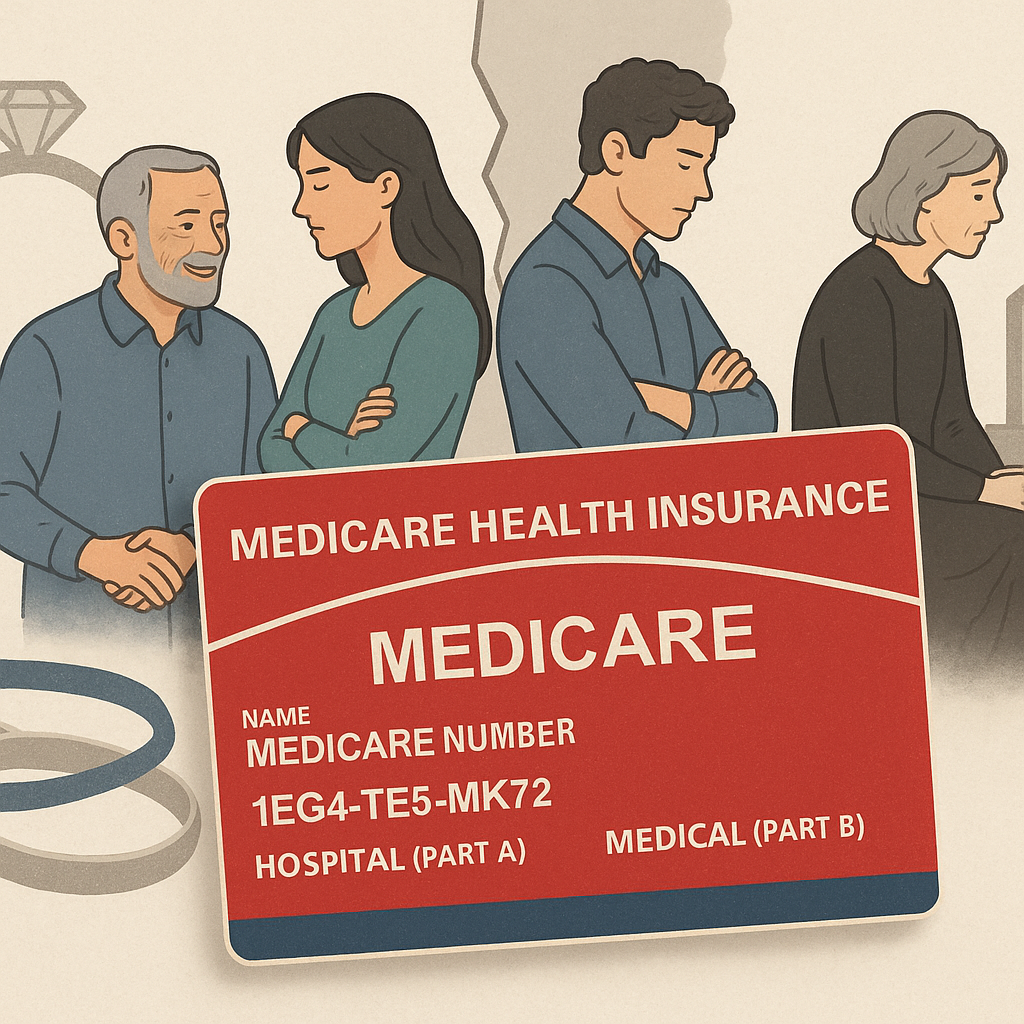
Understanding Medicare Spouse Coverage Eligibility and Rules
One of the most persistent misconceptions about Medicare is that married couples can share a single plan. Unlike employer group health insurance, Medicare is an individual federal health insurance program. Each person must qualify, enroll, and pay separately, there is no family tier, no spouse add-on, and no dependent coverage.
That said, marriage does influence Medicare in meaningful ways. Your spouse's work history may allow you to qualify for premium-free Medicare Part A even if your own earnings record falls short of the required 40 work credits. Your combined household income affects whether you pay a surcharge on Part B and Part D premiums. And changes in legal marital status, whether through divorce, separation, or widowhood, can trigger special enrollment opportunities or alter your eligibility for financial assistance programs.
Understanding how Medicare and spouse coverage interact requires looking at three distinct dimensions: eligibility (who qualifies and through whose record), costs (how joint income affects premiums), and timing (how life events open or close enrollment windows). Each of these dimensions shifts depending on whether you are married, recently divorced, or a surviving spouse. Getting these details right protects both your coverage and your wallet.
Not Sure Which Medicare Plan Is Right for You?
Answer a few quick questions and get matched with plans in your area. Free, no obligation.
Get Started FreeKey Takeaways
- Medicare is an individual program, spouses cannot share a plan or be added as dependents, but a spouse's work record can help you qualify for premium-free Part A.
- Joint tax filing can trigger IRMAA surcharges on Part B and Part D premiums if your combined modified adjusted gross income exceeds $218,000 in 2026.
- Divorce, widowhood, and loss of a spouse's employer coverage each create Special Enrollment Periods and, in some cases, Medigap Guaranteed Issue Rights that protect you from medical underwriting.
How Marital Status Affects Medicare: At a Glance
| Marital Status | Part A Eligibility | IRMAA Impact | Special Enrollment Period (SEP) | Financial Assistance (Extra Help/MSP) |
|---|---|---|---|---|
| Married | Own work record or current spouse's record (if spouse is 62+) | Combined MAGI determines Part B/D surcharges (thresholds start at $218,000 for 2026) | 8-month SEP after active employment or large employer group coverage ends | Combined household income and asset limits apply for programs like Extra Help |
| Divorced | Own record, or ex-spouse's record if marriage lasted at least 10 years and you are unmarried | Based on individual tax filing status (single taxpayer thresholds apply) | 8-month SEP if losing coverage under a former spouse's employer group health plan | Individual income and asset limits apply based on single filing status |
| Widowed | Own record, or deceased spouse's record (survivor benefits available starting at age 60, or 50 if disabled) | Transition from joint to single filing status often reduces or eliminates future IRMAA | 8-month SEP to enroll in Part B after losing deceased spouse's employer group coverage | Single income thresholds apply; drop to single household may expand eligibility |
What Is Medicare Spousal Coverage Eligibility?
Medicare spousal coverage eligibility is the set of rules allowing an individual to access premium-free Part A based on a current or former spouse's Social Security work history rather than their own. Medicare spousal coverage eligibility refers to the rules that allow an individual to access Medicare, particularly premium-free Part A based on a current or former spouse's Social Security work record rather than their own. Normally, you need 40 quarters (10 years) of Medicare-taxed employment to receive Part A at no premium cost. If you have not met that threshold, a qualifying spouse's record can bridge the gap.
To use a current spouse's work record, that spouse must be at least 62 years old and eligible for Social Security retirement benefits. You must also be at least 65 yourself. Spouses who qualify this way receive the same premium-free Part A benefit as if they had earned it directly, but the coverage itself is entirely separate. Each person holds their own Medicare card, their own claims history, and their own policy.
Critically, Medicare does not allow a spouse to be listed as a dependent or beneficiary on another person's Medicare account. You can learn more about official eligibility guidelines through the Social Security Administration. Medicare eligibility is always assessed at the individual level. Part B, Part D, and any supplemental coverage must each be purchased and enrolled in separately by each spouse.
The spousal connection affects how you qualify for Part A, not how you receive or share coverage once enrolled.
Marriage and Medicare: Coordination of Benefits and IRMAA
Medicare spousal coverage eligibility rules in marriage dictate that spouses maintain separate individual policies while coordinating benefits and household income for premium surcharges. When one or both spouses are still working and carry employer-sponsored group health coverage, Medicare's Secondary Payer rules determine which plan pays first. If your employer has 20 or more employees and you are actively working, your group plan pays primary and Medicare pays secondary. Spouses covered under a working partner's large employer plan may be able to delay their own Medicare Part B enrollment without penalty, but only as long as the group coverage qualifies as creditable coverage.
Once employment ends and group coverage terminates, an 8-month Special Enrollment Period begins. Acting within that window is essential to avoid late enrollment penalties on Part B.
Perhaps the most financially significant marriage-related Medicare issue is IRMAA (the Income-Related Monthly Adjustment Amount). IRMAA adds a surcharge to your Part B and Part D premiums based on your modified adjusted gross income (MAGI) from two years prior. For couples filing jointly in 2026, the IRMAA surcharge begins when combined income exceeds $218,000. At that threshold, each spouse's Part B premium rises above the standard $202.90 per month.
At higher income tiers, the monthly Part B premium can reach $689.90 per person. Part D surcharges range from $14. 50 to $91. 00 per month on top of your plan's regular premium.
Same-sex married couples have had full federal recognition since the Supreme Court's 2015 Obergefell decision, meaning they receive identical Medicare spousal benefit treatment as opposite-sex couples. Domestic partnerships and civil unions, however, are not recognized under federal Medicare rules, even if your state grants them legal status. Only legal marriages qualify for derivative Medicare benefits tied to a partner's work record.
Divorce and Medicare: Protecting Your Benefits and Guaranteed Issue Rights
Medicare spousal coverage eligibility after divorce allows you to retain Part A benefits through an ex-spouse's work record as long as your marriage lasted at least 10 years and you remain unmarried. Divorce does not eliminate your Medicare eligibility, but it can change how you qualify for certain benefits. If your own work record is sufficient for premium-free Part A, a divorce has no impact on that entitlement. The greater concern arises when you have been relying on a spouse's record for Part A eligibility or depending on a spouse's employer group plan for your health coverage.
The 10-year marriage rule is key here. If your marriage lasted at least 10 years, you can continue claiming Medicare Part A eligibility through your former spouse's work record, even after divorce, as long as you remain unmarried at the time you apply. You do not need your ex-spouse's cooperation or approval. This rule mirrors the Social Security divorced-spouse benefit and provides critical protection for people who spent years out of the workforce.
Divorce also triggers a Special Enrollment Period when you lose coverage under a former spouse's employer group health plan. You have 8 months from the date coverage ends to enroll in Medicare Part B without a late penalty. Missing this window can result in a 10% per-year permanent premium surcharge. Separately, if you are shopping for a Medicare Supplement plan, certain loss-of-coverage events related to divorce can qualify you for Guaranteed Issue Rights, meaning insurers cannot use your health history to deny you coverage or charge you more during that protected window.
Document everything carefully. Keep records of your former spouse's employer coverage termination date, because that date starts the SEP clock.
If you are approaching 65 and recently divorced after a long marriage, request your Social Security earnings statement and your former spouse's benefit information from the SSA before making any Medicare enrollment decisions. This single step clarifies whether your own work record qualifies you for premium-free Part A or whether you need to claim through your ex-spouse's record, and it prevents you from accidentally delaying enrollment and triggering a lifetime penalty.

If you are approaching 65 and recently divorced after a long marriage, request your Social Security earnings statement and your former spouse's benefit information from the SSA before making any Medicare enrollment decisions. This single step clarifies whether your own work record qualifies you for premium-free Part A or whether you need to claim through your ex-spouse's record - and it prevents you from accidentally delaying enrollment and triggering a lifetime penalty.
Widowhood and Medicare: Navigating Surviving Spouse Transitions
Medicare spousal coverage eligibility for surviving spouses permits you to claim premium-free Part A and survivor benefits based on a deceased spouse's work record starting as early as age 60. Losing a spouse is one of the most disorienting life transitions a person can face, and Medicare rules add another layer of complexity at exactly the wrong moment. Understanding your rights as a surviving spouse in advance can make an already difficult time a little more manageable.
A surviving spouse can claim Medicare eligibility based on their deceased spouse's work record beginning at age 60 (or age 50 if disabled). This is earlier than the standard age-65 Medicare eligibility threshold, and it specifically applies to Social Security survivor benefits that in turn open the door to Medicare. If you are already over 65 when your spouse passes away, you may already be enrolled in your own Medicare, in which case survivor rules primarily affect your financial assistance eligibility rather than your enrollment status.
When a spouse dies and you lose coverage under their employer-sponsored group health plan, you have an 8-month Special Enrollment Period to sign up for Medicare Part B. This SEP begins the month after your spouse's death or the date their employer coverage ends, whichever comes first. Acting promptly is critical, this window does not extend automatically.
Widowhood also changes your household income calculation. Dropping from a joint income to a single income often reduces or eliminates IRMAA surcharges in future years. More immediately, it may expand your eligibility for Extra Help with Part D costs or for Medicare Savings Programs. Because IRMAA looks back two years, you can request a recalculation from SSA using a life-changing event form if your income drops significantly after your spouse's death.
Financial Assistance Programs Tied to Spousal Household Income
Several Medicare financial assistance programs use household income and asset limits to determine eligibility, and your marital status directly affects those calculations. When both spouses are alive, combined income and shared assets are counted together. That can push a household above program thresholds even when each spouse individually might qualify.
For Extra Help (the Low-Income Subsidy for Part D), the 2025 income limit for a married couple is $31,725 per year, compared to $23,475 for an individual. The asset limit for married couples is $35,130, versus $17,600 for a single person. If your income falls within these ranges, Extra Help can dramatically reduce your Part D premium, deductible, and copays, a significant benefit given that the 2026 maximum Part D deductible is $615.
The Qualified Medicare Beneficiary (QMB) and Specified Low-Income Medicare Beneficiary (SLMB) programs follow similar dual thresholds for married versus single households. QMB can cover Part A and Part B premiums, deductibles, and cost-sharing. SLMB covers Part B premiums only. Both programs are administered at the state level, so limits vary slightly by state.
To evaluate which programs you currently qualify for based on your marital status, the Medicare Savings Programs resource and Medicare.gov's benefit eligibility tools are excellent starting points. Reassess your eligibility any time your household composition or income changes significantly.
Avoiding Late Enrollment Penalties During Marital Status Changes
Marital status changes are among the most common, and most avoidable, triggers for Medicare late enrollment penalties. The problem is timing. People often focus on the personal and legal aspects of a divorce or a spouse's death and miss narrow enrollment windows that carry lifelong financial consequences.
The Part B late enrollment penalty is 10% per 12-month period you were eligible but did not enroll without qualifying coverage in place. That penalty is permanent, it stays on your premium for life. The Part D late enrollment penalty is calculated monthly and also follows you indefinitely. Losing a spouse's employer coverage triggers an 8-month SEP for Part B. For Part D, the SEP is generally 2 months from the date your prior creditable drug coverage ends.
The most critical step is contacting the Social Security Administration promptly after any marital status change. SSA handles Medicare enrollment, IRMAA calculations, and survivor benefit records. You will want to report the change, request a new income determination if your earnings dropped significantly, and confirm that your Medicare enrollment records reflect your updated status. Bring documentation: a certified copy of your divorce decree or death certificate, proof of prior coverage's termination date, and your most recent tax return.
If you believe IRMAA surcharges no longer apply because your income has dropped, file SSA Form SSA-44 the Medicare Income-Related Monthly Adjustment Amount Life-Changing Event form, as soon as possible. This allows SSA to use a more recent income year rather than the standard two-year lookback.
Frequently Asked Questions About Medicare Spouse Coverage
No. Medicare does not offer family plans or dependent coverage. Each person must enroll in their own Medicare account based on their individual eligibility. A spouse's work record can help you qualify for premium-free Part A, but coverage itself is always separate.
Medicare has no dependent tier. Even if your spouse is fully enrolled in Medicare, you cannot be added to their coverage. When you turn 65, you must enroll in your own Medicare Part A and Part B to have coverage.
Your individual Medicare eligibility remains intact if you qualify through your own work record. If you relied on your spouse's record for premium-free Part A, you can still use it after divorce, provided the marriage lasted at least 10 years and you have not remarried.
Dropping to a single-person household often lowers your income below IRMAA thresholds and may expand eligibility for Extra Help and Medicare Savings Programs. You also have an 8-month SEP to enroll in Part B if you were covered under your late spouse's employer group plan.
SSA uses your combined modified adjusted gross income from two years prior to determine IRMAA surcharges. For couples filing jointly in 2026, surcharges begin when income exceeds $218,000, pushing each spouse's Part B premium above the standard $202.90 per month. If your income has dropped significantly, you can request a recalculation using SSA's life-changing event process.
Federal Medicare rules do not recognize domestic partnerships or civil unions for the purpose of spousal benefit extensions. Only a legal marriage qualifies you to use a partner's work record for premium-free Part A eligibility or survivor benefits.
Yes, under certain conditions. Losing coverage under a spouse's or former spouse's employer group health plan can trigger Guaranteed Issue Rights for Medicare Supplement plans. You typically have 63 days from the date coverage ends to enroll in a Medigap plan without health questions or premium surcharges based on your medical history.
Contact SSA promptly, in person, by phone, or online, and bring your divorce decree or death certificate, proof of prior coverage, and recent tax information. Report the status change immediately to protect your enrollment timelines and request an IRMAA recalculation if your income has declined.
Conclusion: Managing Your Medicare Strategy Across Life Changes
Medicare is built around individual eligibility, but the financial and enrollment realities of marriage, divorce, and widowhood run through nearly every aspect of how it works. A spouse's work history can open the door to premium-free Part A. A joint tax return can raise both partners' monthly premiums. A divorce or death can create protected enrollment windows, but only if you act within strict timeframes.
The most important habit you can build is proactive attention to timing. Mark the dates when coverage ends, when your marital status changes legally, and when SSA needs to be notified. Review your income picture each year to anticipate IRMAA impacts. And whenever a major life transition occurs, check your eligibility for financial assistance programs, your household income picture may have changed significantly.
For personalized support, Medicare. gov and the Social Security Administration are your most reliable official resources. A licensed Medicare agent can also help you evaluate Special Enrollment Period options and find the right supplemental coverage for your updated situation.
Acting early, before deadlines close, is always the better move.
Does my spouse's Medicare coverage cover me as a dependent?
What happens to my Medicare eligibility if I get divorced?
How does widowhood affect my Medicare and financial assistance?
How does joint tax filing affect my Medicare Part B and Part D premiums?
Do domestic partners qualify for Medicare spousal benefits?
Can I qualify for Medigap without medical underwriting after a divorce or widowhood?
What steps should I take with the Social Security Administration after a marital status change?
Find the Right Medicare Plan for Your Area
Get My Plan RecommendationsRelated Articles
Medicare and HSA Rules: What Happens When You Turn 65
7 min read
Full Retirement Age: What it Means for Medicare and Social Security
8 min read
Understanding How Medicare Works with Employer Health Plans
3 min read
Roth Conversions and Medicare: How to Convert Without Triggering IRMAA Surcharges
10 min read
Have Medicare questions?
Our licensed Medicare agents are available to help you find the right coverage.