


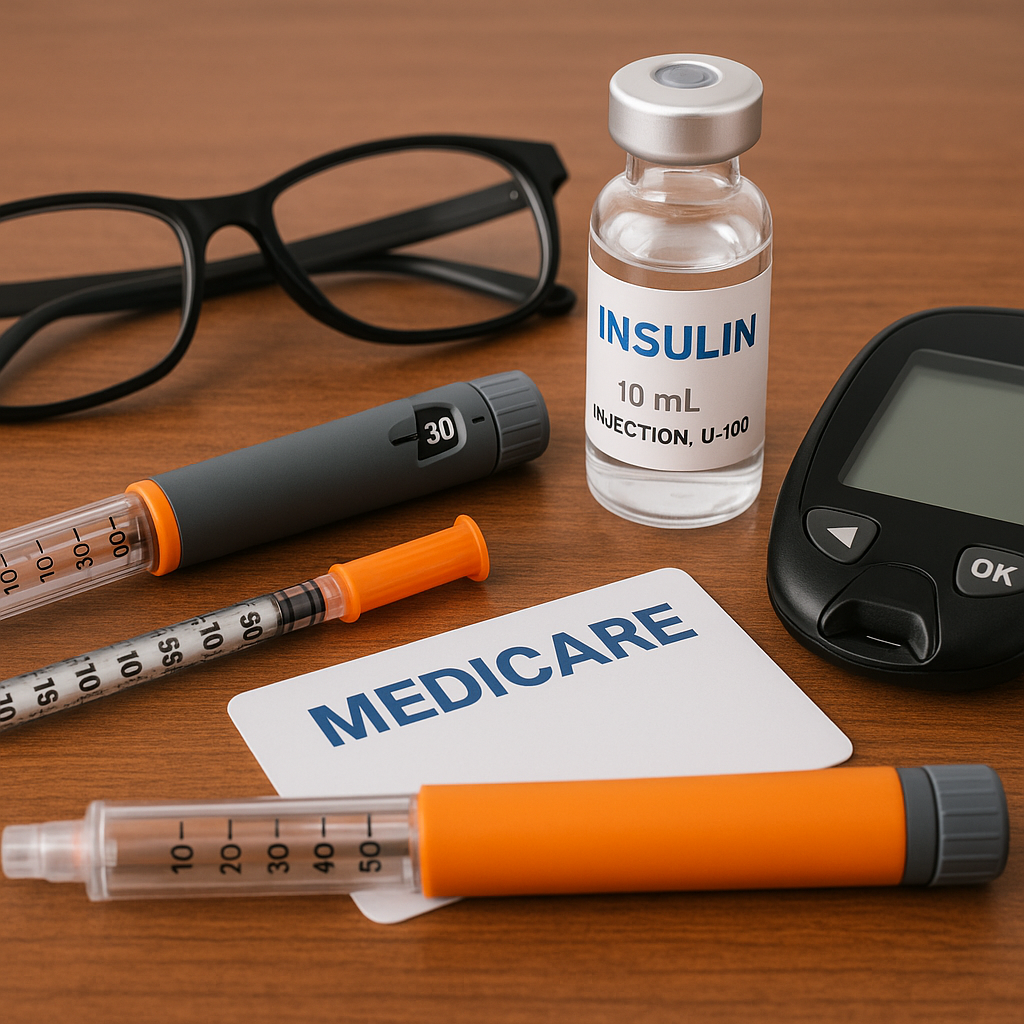
What Is the Medicare $35 Insulin Cap?
The $35 insulin cap is a provision of the Inflation Reduction Act (IRA) that limits how much Medicare beneficiaries pay out of pocket for insulin to no more than $35 per month per covered insulin product. Before this cap took effect in January 2023, many Medicare enrollees paid $100 to $400 or more per month for insulin, depending on their plan's formulary tier and cost-sharing structure. According to CMS, approximately 3.4 million Medicare beneficiaries use insulin, and the cap saves the average insulin user more than $500 per year.
The cap is not optional or plan-specific. Every Medicare Part D plan and every Medicare Advantage plan with drug coverage must comply with the $35 limit. You do not need to apply for the cap, enroll in a special program, or use a manufacturer coupon. It is automatic for all covered insulin products on your plan's formulary.
Key Takeaways
- Medicare caps your out-of-pocket insulin cost at $35 per month per covered insulin product, regardless of the retail price.
- The $35 cap applies to both Part D (pharmacy insulin) and Part B (insulin for pumps), covering all Medicare beneficiaries who use insulin.
- You do not need to meet your Part D deductible before the $35 cap kicks in. The cap applies from your very first fill of the year.
- The cap covers all insulin types and brands on your plan's formulary, including pens, vials, and biosimilars.
- If you use multiple insulin products (such as a long-acting and a rapid-acting insulin), the $35 cap applies separately to each covered product.
- The $35 you pay each month does count toward your Part D $2,000 annual out-of-pocket cap.
How the $35 Cap Works at the Pharmacy
Not Sure Which Medicare Plan Is Right for You?
Answer a few quick questions and get matched with plans in your area. Free, no obligation.
Get Started FreeWhen you fill an insulin prescription at the pharmacy, your plan automatically applies the $35 cap at the point of sale. You will never see a higher cost on the register for a covered insulin product, regardless of what coverage phase you are in (deductible, initial coverage, or coverage gap). Here is how it works in practice:
| Coverage Phase | Without the Cap (Example) | With the $35 Cap |
|---|---|---|
| Deductible phase | You pay full retail ($350 for a box of pens) | You pay $35 |
| Initial coverage phase | You pay 25% coinsurance ($87.50) | You pay $35 |
| Coverage gap (donut hole) | Previously 25% coinsurance | You pay $35 |
| Catastrophic phase | 5% coinsurance ($17.50) | You pay $17.50 (less than $35, so cap does not apply) |
In the catastrophic phase, if your normal cost-sharing is already below $35, you pay the lower amount. The cap sets a ceiling, not a floor.
Which Insulin Products Are Covered?
The $35 cap applies to all insulin products that are on your specific plan's formulary (covered drug list). This includes brand-name insulins, biosimilar insulins, and authorized generics across all delivery methods.
Covered Insulin Types
Rapid-acting insulin (Humalog, NovoLog, Fiasp, Admelog, Lyumjev, and biosimilars)
Short-acting insulin (Humulin R, Novolin R)
Intermediate-acting insulin (Humulin N, Novolin N)
Long-acting insulin (Lantus, Basaglar, Levemir, Tresiba, Toujeo, Semglee, and biosimilars)
Pre-mixed insulin combinations (Humalog Mix, NovoLog Mix, Humulin 70/30)
Concentrated insulins (Humulin R U-500, Toujeo Max)
Covered Delivery Methods
Insulin vials (for use with syringes)
Insulin pens (pre-filled and reusable)
Insulin cartridges (for compatible pen devices)
Insulin for use in pumps (covered under Part B, not Part D)
If your preferred insulin product is not on your plan's formulary, the $35 cap does not apply to it. However, you can request a formulary exception from your plan, switch to a covered alternative, or change plans during the Annual Enrollment Period to one that covers your specific insulin.
Part B Insulin Coverage (Insulin Pumps)
If you use an insulin pump, your insulin is covered under Medicare Part B rather than Part D. The $35 monthly cap still applies to Part B insulin, but the billing works differently. Instead of paying at the pharmacy, your Part B insulin is typically supplied through a durable medical equipment (DME) supplier. The $35 cap applies per month of supply, and your DME supplier should apply it automatically.
Part B also covers the insulin pump itself, pump supplies (infusion sets, reservoirs, and batteries), and the insulin to fill it. The $35 cap applies only to the insulin portion, not to the pump hardware or supplies, which remain subject to standard Part B cost-sharing (20% coinsurance after the $283 annual deductible in 2026).

If you are paying more than $35 for insulin at the pharmacy, something is wrong. Either the specific product is not on your plan's formulary, or the pharmacy's system has not been updated correctly. Do not just pay the higher amount. Ask the pharmacist to reprocess the claim, call your plan's member services number, or contact 1-800-MEDICARE. I have seen cases where a simple reprocessing at the pharmacy counter fixed the issue immediately. You should never pay more than $35 for a covered insulin product under Medicare.
The $35 Cap and the $2,000 Annual Out-of-Pocket Limit
The $35 you pay each month for insulin counts toward your Part D annual out-of-pocket cap of $2,000. If you take insulin plus other expensive medications, your combined spending will eventually reach the $2,000 limit, at which point you pay $0 for all covered Part D drugs (including insulin) for the rest of the year. For beneficiaries who only take insulin and no other expensive drugs, the $35 monthly cap means you would spend a maximum of $420 per year on insulin ($35 x 12 months), well below the $2,000 annual limit.
What If You Use Multiple Insulin Products?
Many people with diabetes use two or more insulin products, such as a long-acting basal insulin (like Lantus or Tresiba) plus a rapid-acting mealtime insulin (like Humalog or NovoLog). The $35 cap applies separately to each covered insulin product per month. This means if you use two different insulins, your maximum monthly insulin cost is $70 ($35 for each product), not $35 total.
However, if you fill a 90-day supply of insulin through a mail-order pharmacy, the $35 cap applies per month of supply within that fill. A 90-day supply would cost you a maximum of $105 ($35 x 3 months), which is the same as filling monthly at a retail pharmacy.

Who Does NOT Qualify for the $35 Cap?
The $35 insulin cap is specific to Medicare. It does not apply to people with private insurance, employer coverage, or individual ACA marketplace plans (though some states have enacted their own insulin caps for commercial insurance). Additionally, the cap does not apply if:
You do not have Medicare Part D or a Medicare Advantage plan with drug coverage
Your specific insulin product is not on your plan's formulary
You purchase insulin from a pharmacy outside your plan's network
You are buying insulin without using your Medicare drug benefit (paying cash)
Frequently Asked Questions About the Medicare Insulin Cap
Do I need to apply for the $35 insulin cap?
Does the $35 cap apply to insulin needles and syringes?
What if my insulin costs less than $35?
Does the cap apply to GLP-1 drugs like Ozempic or Mounjaro?
Can I get insulin for $35 at any pharmacy?
Find the Right Medicare Plan for Your Area
Get My Plan RecommendationsFrequently Asked Questions
Do I need to apply for the $35 insulin cap?
Does the $35 cap apply to insulin needles and syringes?
What if my insulin costs less than $35?
Does the cap apply to GLP-1 drugs like Ozempic or Mounjaro?
Can I get insulin for $35 at any pharmacy?
Related Articles
How is Medicare Part D Changing in 2026?
4 min read
Medicare's Drug Price Negotiation Program: What It Means for Beneficiaries in 2026 and Beyond
12 min read
Does Medicare Cover Ozempic? 2026 Guide to Costs, Coverage, and Savings
15 min read
Medicare and Prescription Drugs: What Is Covered and What Is Not?
8 min
Have Medicare questions?
Our licensed Medicare agents are available to help you find the right coverage.