


What Documents Do You Need to Apply for Medicare? A Quick Answer
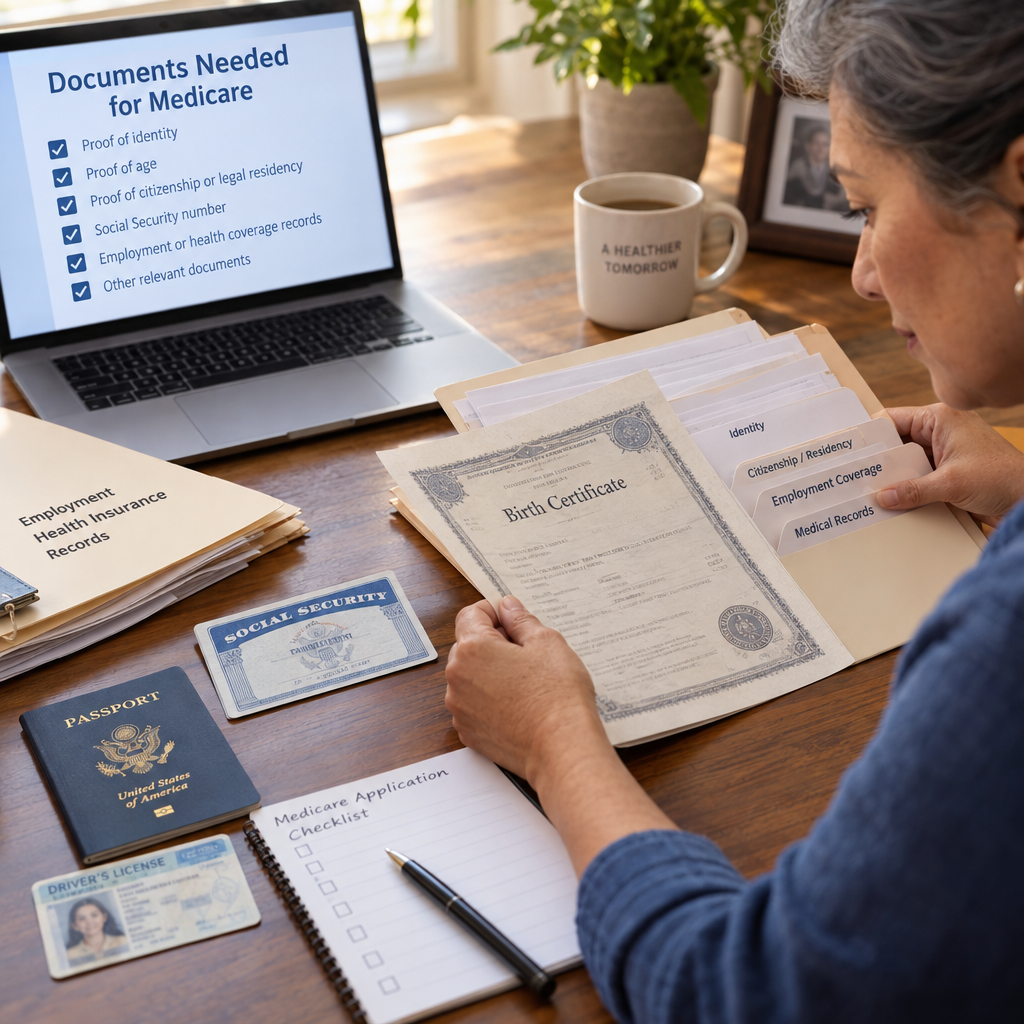
Most people applying for Medicare need to show proof of identity, age, and citizenship or legal residency, along with their Social Security number. Depending on your situation, you may also need employment or health coverage records, military discharge papers, or disability-related paperwork.
Gathering these items before you start your application, whether online, by phone, by mail, or in person, helps you avoid delays, errors, or an incomplete submission that gets sent back for follow-up. Exactly which documents apply to you depends on whether you're enrolling based on age, disability, or a Special Enrollment Period, and on how you choose to apply.
The rest of this article breaks down each document category step by step, so you know precisely what to pull together before your appointment, call, or online session.
Key Takeaways
Most applicants need proof of identity, age, citizenship or legal residency, and a Social Security number before starting a Medicare application. If you're delaying Part B because of employer coverage, you'll need the CMS-L564 form completed by your employer, and that coverage must not have ended more than 8 months before you apply. If you're qualifying through disability, you generally must receive Social Security Disability Insurance (SSDI) for 24 months before Medicare eligibility begins, though this waiting period is waived for ALS and ESRD. Missing a document doesn't have to stall your timeline if you start requesting replacements early. Use the checklist later in this article to confirm you have everything ready before you apply online, by phone, by mail, or in person.
SSDI Waiting Period and SEP Timing at a Glance
SSDI waiting period for Medicare: generally 24 months of receiving Social Security Disability Insurance benefits before Medicare eligibility begins. Waived waiting period: ALS and ESRD qualify for Medicare on a different timeline, without the standard 24-month wait. Part B Special Enrollment Period timing: your group health plan coverage must not have ended more than 8 months before you apply, per current CMS-L564 instructions. For exact current figures and rules, confirm directly through ssa.gov or cms.gov.
Key Takeaways
- Most applicants need proof of identity, age, citizenship or legal residency, and a Social Security number.
- Those delaying Part B due to employer coverage need a completed CMS-L564 form, with coverage ending no more than 8 months before applying.
- Required documents vary depending on whether you're enrolling by age, disability, or a Special Enrollment Period.
- Missing documents don't have to delay your application if you request replacements early.
- Organizing paperwork in advance helps prevent delays and prepares you for plan comparisons once enrolled.
Before You Start: Who Needs to Gather Documents and Why It Matters
If your 65th birthday is approaching, or you've recently learned you qualify for Medicare through disability, taking a little time now to organize your paperwork can prevent a lot of frustration later. An application that's missing a required document often gets delayed while Social Security follows up, which can be stressful if you're also watching an enrollment deadline.
This guide applies to two main groups: people aging into Medicare around 65, and people qualifying earlier through Social Security's disability process. Each group has some overlapping paperwork and some differences, which are covered in the sections below.
Having your documents organized also puts you in a better position once you're enrolled. When it's time to compare plans against your doctors, prescriptions, and budget, you'll already have the personal information on hand that a licensed agent may ask about, without needing to track anything down under time pressure.
Step 1: Confirm Your Eligibility Requirements for Medicare Before Gathering Paperwork
Before you start pulling documents together, take a moment to identify which category you fall into: enrolling based on age, enrolling based on disability, or enrolling later through a Special Enrollment Period after delaying Part B. This isn't about relearning the general Medicare eligibility requirements, it's simply about knowing which paperwork section below actually applies to you.
Someone turning 65 with no other coverage will mainly need identity, age, and citizenship documents. Someone applying through disability will need some additional medical and work history records. Someone enrolling later because they had employer coverage will need proof of that coverage. Once you know your category, skip ahead to the matching steps and treat the others as optional reading.
Step 2: Gather Proof of Identity, Age, and Citizenship or Legal Residency
Social Security needs to confirm who you are, when you were born, and that you're a U.S. citizen or lawfully present resident before it can process your Medicare application. This is a standard verification step for every applicant, regardless of age or health status, and it's usually the first thing that holds up an application if something is missing or doesn't match Social Security's records.
Birth certificate, or an acceptable substitute if the original isn't available
U.S. passport
Driver's license or other state-issued photo ID
Social Security card, or at minimum your Social Security number
Proof of citizenship or lawful immigration status, such as naturalization papers or a permanent resident card, if you weren't born in the United States
Social Security generally prefers to see original documents or specific accepted copies rather than ordinary photocopies. Because requirements can vary slightly by document type and by local office, it's worth confirming exactly what will be accepted before you mail anything irreplaceable. The Social Security Administration's Program Operations Manual System (POMS) outlines accepted evidence types in more detail, and you can review current guidance through secure.ssa.gov/poms.nsf if you want to confirm a specific document type before you apply.
What Identification Is Needed for Your Medicare Application?
| Document | What It Proves |
|---|---|
| Birth certificate | Date of birth, and sometimes citizenship if issued in the U.S. |
| U.S. passport | Identity and citizenship |
| Driver's license or state ID | Identity |
| Social Security card | Social Security number |
| Naturalization certificate or permanent resident card | Citizenship or lawful immigration status |
You typically don't need to provide every item on this list. In most cases, one strong proof of identity, such as a passport or driver's license, combined with one document establishing age and citizenship or residency status, is enough. If you're unsure whether a document you have on hand qualifies, a quick call to your local Social Security office can save you a wasted trip or a returned mailing.
Step 3: If You're Applying Due to Disability, Gather These Additional Records
If you're qualifying for Medicare through disability rather than age, you'll generally go through Social Security's disability determination process first, which involves more documentation than a standard age-based application. Social Security needs enough medical and work history information to evaluate your claim.
In most cases, you must receive Social Security Disability Insurance (SSDI) benefits for 24 months before Medicare coverage begins. This waiting period is waived if you have amyotrophic lateral sclerosis (ALS) or end-stage renal disease (ESRD), both of which qualify you for Medicare on a different timeline.
Medical records and contact information for the doctors and facilities that have treated your condition
A summary of your work history, including past employers and job duties
Information about any workers' compensation or other disability benefits you currently receive or have applied for
Because disability-based applications tend to be more involved than age-based enrollment, it's worth confirming the exact paperwork Social Security needs for your specific situation directly with the agency rather than relying solely on a general checklist.
If you have limited income and resources, you may also qualify for a Medicare Savings Program to help with premiums and cost-sharing, or for Extra Help with Part D prescription drug costs. These programs typically require documentation of your income, resources, and household size, so it's worth gathering recent pay stubs, bank statements, and benefit award letters if you plan to apply. Your state Medicaid office or the Social Security Administration can confirm exactly which documents are needed for these programs.
Step 4: Collect Information About Current or Prior Employer Health Coverage
If you or your spouse have group health coverage through a current job, Medicare needs documentation of that coverage, especially if you decided to delay Part B enrollment while relying on that plan. This information helps confirm you qualify for a Special Enrollment Period later, rather than being treated as someone who simply enrolled late.
The main form involved here is the CMS-L564, Request for Employment Information. This form generally needs to be completed in part by your employer, confirming your coverage dates and the nature of your group health plan.
Coverage Timing Rule
Per current CMS-L564 instructions, your group health plan coverage must have continued since the first month you were eligible for Medicare Part B, and it must not have ended more than 8 months before you apply.
This timing detail matters because it's the rule CMS uses to confirm you're within your Part B Special Enrollment Period window rather than outside it. Part B Special Enrollment Period eligibility is governed by its own set of rules separate from the Part D late enrollment penalty framework, so coverage that satisfies the Part B SEP timing requirement does not automatically determine whether a Part D late enrollment penalty applies. You can review the exact wording on the form itself through the CMS-L564 instructions. Medicare.gov's enrollment checklist also outlines the documentation generally expected for Special Enrollment Periods, and is worth reviewing alongside the form instructions.
If your employer is unable or unwilling to complete their section of the form, CMS guidance has historically pointed to alternative forms of evidence, including:
Income tax returns showing health insurance premiums paid
W-2 forms reflecting pre-tax medical contributions
Pay stubs showing health insurance premium deductions
Insurance cards showing a policy effective date
Explanations of benefits paid by the group health plan
This alternative evidence list was outlined in CMS enrollment guidance, but since acceptability can change, confirm with Social Security directly whether these substitutes will work for your specific application before relying on them.

If you know you'll need your employer to sign the CMS-L564, ask your HR department early, even before you've decided exactly when you'll apply. Employer paperwork is often the slowest piece of a Medicare application to track down, and starting that conversation weeks ahead can prevent a last-minute scramble near your enrollment deadline.
Step 5: If You Served in the Military, Locate Your Discharge Papers
If you served in the military, you may need to provide your discharge papers, commonly known as a DD-214, in certain situations. This can come up when your service dates affect the timing of your eligibility or when other veterans' benefits need to be coordinated with your Medicare coverage.
If you can't locate your original DD-214, you can request a replacement through the National Archives rather than treating a missing copy as a roadblock to your application.
Step 6: If You're Applying Late Due to a Special Enrollment Period, Prepare Extra Proof
This step applies specifically to people who delayed Part B because they had health coverage through their own or a spouse's current employment, and who are now enrolling outside of their Initial Enrollment Period. Because you're applying later than the standard window, Social Security needs clear documentation that your coverage situation qualifies you for a Special Enrollment Period rather than a late penalty.
The same CMS-L564 requirement from Step 4 applies here, including the rule that your coverage must not have ended more than 8 months before you apply. This timing limit is specifically what determines whether you qualify for the Part B Special Enrollment Period and avoid the Part B late enrollment penalty. The Part D late enrollment penalty follows its own separate set of rules based on creditable prescription drug coverage, so it's worth confirming both your Part B coverage end date and your Part D creditable coverage status before you submit anything.
Because getting your employer's section of the CMS-L564 completed can take time, start that process as early as possible rather than waiting until your enrollment window is close to closing.
Step 7: Choose How You'll Apply - and Know If That Changes What You Need
You can apply for Medicare in one of four ways: online at ssa.gov, by phone, by mail, or in person at a Social Security office. The underlying list of required information is the same no matter which method you choose, but how and when you present your documents can differ.
Online at ssa.gov: you enter your information electronically, and Social Security may follow up separately if additional verification is needed. If you don't already have one, you'll need to create a mySocialSecurity.gov account to start and track your application
By phone: a representative walks you through the required information and lets you know what, if anything, needs to be mailed or brought in afterward
By mail: you'll need to carefully package original documents or the specific copies Social Security accepts, since mailed items can take time to process and return
In person at a Social Security office: you can often show original documents on the spot, which some people prefer if they're uneasy about mailing irreplaceable paperwork
Before mailing any original document, call ahead or check ssa.gov to confirm what's actually required, since replacing a lost original can take several weeks and could affect your enrollment timing.
What to Do If You're Missing a Required Document
Missing a document doesn't have to derail your Medicare application timeline, as long as you start addressing it as soon as you realize it's needed.
Contact your state's vital records office to request a replacement birth certificate
Request a replacement Social Security card through ssa.gov
Contact the National Archives for replacement military discharge records if your DD-214 is missing
Ask your employer's HR department to complete the CMS-L564 as early as possible if you're relying on that form
Each of these replacement processes can take time, so the earlier you start, the less likely a missing document is to interfere with your enrollment window.
Checklist: List of Required Documents for Medicare Enrollment
Here's the full list in one place, organized by category, so you can review it before your appointment, call, or online session.
Identity and citizenship: birth certificate or acceptable substitute, U.S. passport, driver's license or state ID, Social Security card or number, naturalization certificate or permanent resident card if applicable
Employment and coverage: CMS-L564 completed by your employer, or alternative evidence such as tax returns, W-2s, pay stubs, insurance cards, or explanations of benefits
Disability-specific: medical records and treating doctor contact information, work history summary, workers' compensation or other disability benefit details, and confirmation of your 24-month SSDI waiting period status (waived for ALS and ESRD)
Military: DD-214 discharge papers, if your service dates affect eligibility timing or benefits coordination
Low-income assistance: income, resource, and household documentation if you're applying for a Medicare Savings Program or Extra Help with prescription drug costs
Frequently Asked Questions About Medicare Application Documents
What documents do I need to apply for Medicare if I'm turning 65?
I'm not ready to talk to anyone yet, can I gather documents without starting the application?
Will I get a pushy sales call if I ask for help understanding Medicare documents?
Can I figure out the Medicare application process on my own without help?
What identification is needed if I don't have a passport or driver's license?
How do I know which source to trust for Medicare enrollment information?
What happens if I submit my Medicare application without all my documents?
Do enrollment forms differ if I apply by mail versus online?
Your Next Step: Get Organized, Then Get Confident About Your Coverage
Gathering your documents ahead of time is one of the most effective things you can do to keep your Medicare application moving without delays. Use the checklist above to confirm you have what you need before your appointment, phone call, or online session.
Once you're enrolled, the next natural step is comparing your coverage options against your doctors, prescriptions, and budget. Licensed help is available whenever you're ready to take that step, on your own timeline.
Related Articles
Have Medicare questions?
Our licensed Medicare agents are available to help you find the right coverage.